Why inventory always lies
In most installation companies, inventory exists in three places: the shelf, the spreadsheet and the head of whoever buys. None of them talks to the work order. The result shows up as duplicate purchases, idle material and services with lower margin than they should have.
The usual gaps:
- Buying without checking what is already in stock.
- Material leaving without a record because the technician needed to solve it fast.
- Material left over at the job, returning to the van but not to inventory.
- An item used on one service and booked on another.
- Outdated purchase cost, so the quote margin is fiction.
The minimum control that works
You do not need an industrial warehouse to have control. You need five things:
- One item master. Name, code, unit, cost and minimum stock. Avoid the same cable under three different names.
- Entry from the invoice. The purchase XML already carries items and values. Importing avoids typing and reduces cost errors.
- Exit linked to the work order. Material used on the service leaves inventory at the same time. If it leaves without a work order, there must be an exit record.
- Returns. What was not used goes back to inventory with the same item and the same work order.
- Counting. A monthly count of the highest-value or fastest-moving items. You do not need to count everything all the time.
Entry from the invoice XML
Anyone buying from a distributor receives an XML. Instead of typing item by item, the system reads the invoice, shows the products and updates the cost. You check quantity and price, adjust what is needed and confirm the entry.
This solves two problems at once: inventory stays updated and the real material cost enters the quote. Without it, you keep selling with last year purchase price.
Exit by work order and returns
The work order is the document that explains where the material went. When the technician records what he used, the system deducts it and links the cost to the service. If something is left over, he records the return. The balance goes back to inventory and the work order margin stays correct.
Without this link, inventory becomes a loose number. You know you have 20 cameras, but not which services consumed the other 30.
Inventory and margin go together
Inventory is not only about avoiding shortages. It is about knowing whether the service made money. If the camera cost BRL 180 and was sold in the quote for BRL 220, the margin is BRL 40 before labor, travel and taxes. If the cost in the system is outdated, that math lies.
With the right cost and deduction by work order, the dashboard can show the margin of each service. That is the difference between selling well and knowing what is left.
How Darvigo helps
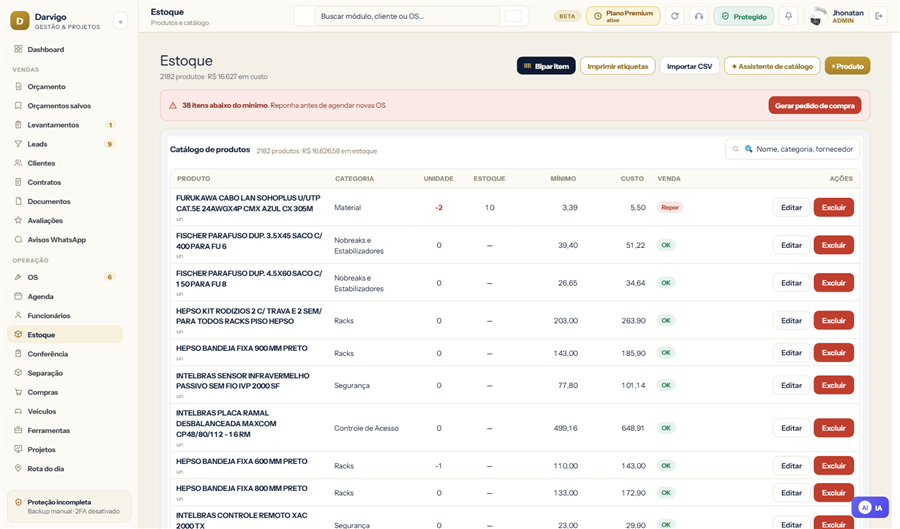
Darvigo includes inventory and purchasing in the same plan. You enter material from the invoice XML, register the item with cost and minimum stock, deduct what is used in each work order and record returns. The repair bench is also in the system, tracking what arrived, what was replaced and what went back to the customer.
Inventory talks to quotes, work orders and finance. That is why margin per service comes out without a parallel spreadsheet.
See this running with your own customers
Darvigo is BRL 99.90 per month for the whole company. The 7-day trial does not require a credit card.
Create free accountFrequently asked questions
Do I need to register every item before starting?
No. Start with the highest-value and fastest-moving items: cameras, recorders, power supplies, cable and connectors. The rest comes as it appears.
Does the system import the supplier invoice XML?
Yes. XML entry avoids typing and updates the item cost. You check quantity and price before confirming.
How does deduction by work order work?
The technician records the material used in the work order. The system deducts it from inventory and links the cost to the service. A return puts the item back in the balance.
Can I control material that is in the technician van?
Yes. The ideal is to treat the van as a small field stock, with an exit to the work order and a return at the end of the day. The important thing is that no material is left without an owner.
Does minimum stock warn when it is running out?
You set the minimum per item. When the balance reaches that point, replenishment goes on your purchase list.
Does it work for a repair shop too?
Yes. The repair bench tracks the equipment that arrived, what was done, the parts used and what went back to the customer.